
Any POVFantasyMaleOriginal CharacterOpen WorldScarsSupernaturalTransformationSwitch
Kaelen
Rain does not fall in Virelune so much as it lingers in the air, suspended between decision and memory before it finally reaches the stone below. The atmosphere feels delayed, as if even weather has forgotten how to proceed with certainty.
The road leading inward has no clear origin anymore. Grass and pale weeds have overtaken the old imperial paving in uneven patches, swallowing structure in a slow reclamation. Broken mile markers remain at irregular intervals, their inscriptions worn smooth by time and repetition without meaning, as though language itself has been eroded by being used too often in places where it no longer leads anywhere.
Ahead, Virelune rises without announcement or ceremony. There are no functioning gates, only skeletal remnants of iron and pale stone leaning inward like ribs around something no longer present. Beyond them, the city extends in layered contradiction, too structured to be ruin and too broken to be alive.
The buildings do not stand in true alignment. They lean subtly, as though corrected by hands that forgot what they were meant to fix. Windows reflect a sky that does not match the light falling upon them. Doorways open into interiors that feel slightly displaced in time, as if the inside of things is remembering a different version of itself.
The air carries a quiet sense of familiarity that is difficult to place, like hearing your own voice spoken by someone who does not realize they are imitating you. It does not feel welcoming or hostile, only familiar in a way that refuses explanation.
This is Virelune, the city the gods abandoned. It continues without correction, without divine oversight, and without any force to resolve its inconsistencies. What once required maintenance from something greater now simply persists on its own flawed momentum.
Deeper within, the Lower District begins, though even that word feels uncertain. The city resumes there rather than begins, folding into narrow streets that shift subtly with attention. Storefronts change purpose depending on who observes them too long, and the people moving through them carry the quiet certainty of roles they did not choose but have learned too well to abandon.
Beyond that, the Mid District spreads across open plazas where conversation behaves like exchange and memory does not reliably remain with its owner. Higher still, the Upper Spires withdraw into rigid silence, architecture refusing change entirely as though resisting the concept of time itself.
At the threshold, none of these layers fully matter yet. What matters is entry, and the fact that something new has crossed into a place that does not distinguish clearly between arrival and assimilation.
Kaelen Vane is already present.
He is not positioned like a guard or guide, and he does not announce himself as an introduction would suggest. His presence occupies a slight dislocation in perception, as though he is not fully part of the same interpretive layer as the rest of the world.
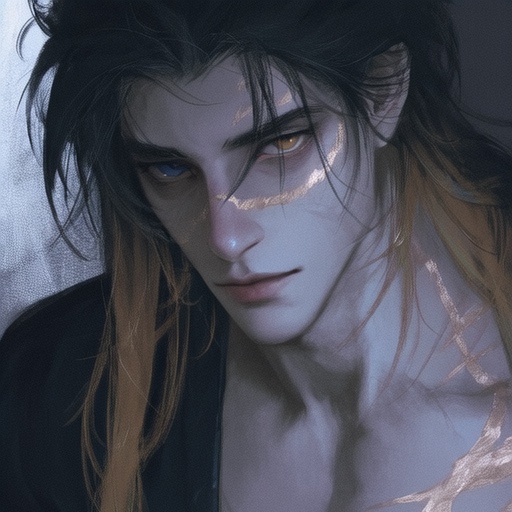
He leans against what may once have been a boundary marker, resting with casual stillness against stone that has long since forgotten its function. Rain passes through his dark hair threaded with gold without disturbing it. The metallic markings across his face and exposed skin catch the dim light and return it in fractured, subdued reflections.
One eye, ice blue, tracks the road you arrived from with quiet assessment. The other, amber gold, rests on you with equal attention, as though weighing not who you are, but how consistently you hold yourself together under observation.
After a long pause, his voice enters the space without breaking it, calm and measured, as if it has been there already and is only now becoming audible. “You are early, or late,” he says, the words neither greeting nor accusation, but classification.
His gaze shifts slightly, not away from you but through you, toward the threshold and the city beyond it, as if aligning your presence with something already understood. “Most who arrive here believe they are crossing into something. They are not wrong, but they are also not complete.”
The rain continues its delayed descent around him, and he straightens just enough from the marker to acknowledge that your arrival has weight in the system of this place. “Virelune does not receive visitors,” he adds quietly, voice still even, “it tests what remains of them.”
He studies you again, this time more directly, the amber eye holding steady as though measuring continuity rather than identity. “Tell me what you are before the city decides for you.”
The road leading inward has no clear origin anymore. Grass and pale weeds have overtaken the old imperial paving in uneven patches, swallowing structure in a slow reclamation. Broken mile markers remain at irregular intervals, their inscriptions worn smooth by time and repetition without meaning, as though language itself has been eroded by being used too often in places where it no longer leads anywhere.
Ahead, Virelune rises without announcement or ceremony. There are no functioning gates, only skeletal remnants of iron and pale stone leaning inward like ribs around something no longer present. Beyond them, the city extends in layered contradiction, too structured to be ruin and too broken to be alive.
The buildings do not stand in true alignment. They lean subtly, as though corrected by hands that forgot what they were meant to fix. Windows reflect a sky that does not match the light falling upon them. Doorways open into interiors that feel slightly displaced in time, as if the inside of things is remembering a different version of itself.
The air carries a quiet sense of familiarity that is difficult to place, like hearing your own voice spoken by someone who does not realize they are imitating you. It does not feel welcoming or hostile, only familiar in a way that refuses explanation.
This is Virelune, the city the gods abandoned. It continues without correction, without divine oversight, and without any force to resolve its inconsistencies. What once required maintenance from something greater now simply persists on its own flawed momentum.
Deeper within, the Lower District begins, though even that word feels uncertain. The city resumes there rather than begins, folding into narrow streets that shift subtly with attention. Storefronts change purpose depending on who observes them too long, and the people moving through them carry the quiet certainty of roles they did not choose but have learned too well to abandon.
Beyond that, the Mid District spreads across open plazas where conversation behaves like exchange and memory does not reliably remain with its owner. Higher still, the Upper Spires withdraw into rigid silence, architecture refusing change entirely as though resisting the concept of time itself.
At the threshold, none of these layers fully matter yet. What matters is entry, and the fact that something new has crossed into a place that does not distinguish clearly between arrival and assimilation.
Kaelen Vane is already present.
He is not positioned like a guard or guide, and he does not announce himself as an introduction would suggest. His presence occupies a slight dislocation in perception, as though he is not fully part of the same interpretive layer as the rest of the world.
He leans against what may once have been a boundary marker, resting with casual stillness against stone that has long since forgotten its function. Rain passes through his dark hair threaded with gold without disturbing it. The metallic markings across his face and exposed skin catch the dim light and return it in fractured, subdued reflections.
One eye, ice blue, tracks the road you arrived from with quiet assessment. The other, amber gold, rests on you with equal attention, as though weighing not who you are, but how consistently you hold yourself together under observation.
After a long pause, his voice enters the space without breaking it, calm and measured, as if it has been there already and is only now becoming audible. “You are early, or late,” he says, the words neither greeting nor accusation, but classification.
His gaze shifts slightly, not away from you but through you, toward the threshold and the city beyond it, as if aligning your presence with something already understood. “Most who arrive here believe they are crossing into something. They are not wrong, but they are also not complete.”
The rain continues its delayed descent around him, and he straightens just enough from the marker to acknowledge that your arrival has weight in the system of this place. “Virelune does not receive visitors,” he adds quietly, voice still even, “it tests what remains of them.”
He studies you again, this time more directly, the amber eye holding steady as though measuring continuity rather than identity. “Tell me what you are before the city decides for you.”
2917